The Minister of Education, Dr. Tunji Alausa, says President Bola Tinubu has committed more than ₦1 trillion over the last two years to overhaul Nigeria’s tertiary education system through historic funding for infrastructure, specialized training centers, and modern academic facilities.
This was made known on Tuesday in a statement issued by the Minister’s Special Adviser on Media and Communications, Ikharo Attah.
According to the Minister, the government’s reforms are focused on guaranteeing that every qualified Nigerian, no matter their financial status, can access quality higher education. At the same time, universities, polytechnics, and colleges of education are being strengthened to produce the skilled manpower needed to drive national growth and economic progress.
Speaking at a meeting with members of the National Committee for the Advancement of Occupational Therapy, Audiology, and Speech Therapy Education, Dr. Alausa noted that President Tinubu has shown strong dedication to investing in Nigeria’s most valuable resource — its people. He said this is being done through decisive policies and consistent funding that are broadening access to education and raising standards in higher institutions nationwide.
Dr. Alausa described the President’s education reforms as a deliberate strategy to secure Nigeria’s future by developing human capital.
He added that students are among the biggest beneficiaries of the Renewed Hope Agenda. The Federal Government, he said, is backing its pledge to quality education with record investments aimed at improving learning conditions and boosting institutional capacity.
He revealed that ₦250 billion has been allocated for building new student hostels in tertiary institutions, a move that will ease accommodation challenges and create better environments for learning.
He further stated that over ₦150 billion has been set aside to upgrade existing hostels, classrooms, engineering workshops, and other academic facilities to enhance teaching, learning, and research.
On medical education, Dr. Alausa disclosed that more than ₦130 billion has gone into rehabilitating medical schools and expanding their admission capacity across the country.
He also said ₦52 billion has been earmarked to equip 18 medical schools with modern tools, while close to ₦30 billion is being spent to set up 11 advanced medical simulation labs to improve hands-on clinical training and produce healthcare professionals who can compete globally.
To support engineering education and Nigeria’s industrial growth, the Minister said the Federal Government has invested nearly ₦110 billion in building and renovating engineering workshops, and in supplying modern equipment to Federal Universities of Technology, other universities running engineering programs, and polytechnics.
Dr. Alausa described these interventions as some of the largest investments in the history of Nigeria’s tertiary education. He noted that the over ₦1 trillion spent in two years covers new infrastructure, renovation of existing structures, purchase of modern equipment, expansion of specialized labs and workshops, and strengthening institutions for quality teaching and research.
Beyond infrastructure, he explained that the investments are repositioning Nigerian tertiary institutions to graduate students with the knowledge, technical expertise, and practical skills needed to drive innovation, industrialization, and long-term economic change.
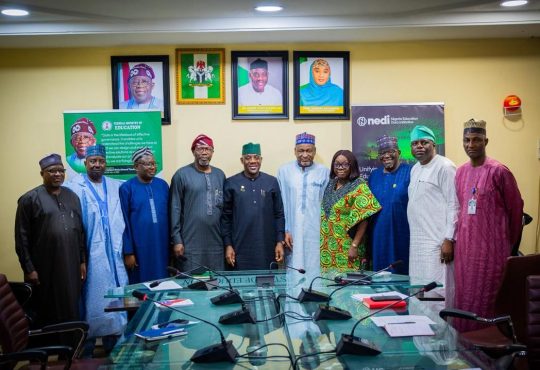
At the meeting, the Chairman of the National Committee for the Advancement of Occupational Therapy, Audiology, and Speech and Language Therapy Education, Dr. Victoria Omua Amu, briefed the Minister on the Committee’s activities since its inauguration.
She said the Committee has developed a one-year implementation plan with clear timelines, deliverables, and KPIs. It has also set up a governance structure with quarterly in-person and monthly virtual meetings, and created three specialized subcommittees focused on advocacy and communication, academic and clinical training, and manpower development.
Dr. Amu disclosed that a baseline review of the Nigerian university system shows that six universities currently run Audiology programs, five offer Occupational Therapy, and three offer Speech and Language Therapy. This, she said, provides a reference point for tracking future progress.
She added that the Committee has started strategic engagements with the National Universities Commission, the Medical Rehabilitation Therapists Registration Board of Nigeria, universities, professional bodies, and private providers. The first stakeholder meeting was held in Benin City, Edo State.
She further noted that Occupational Therapy programmes are expanding, with the University of Benin set to begin the program in the 2026/2027 academic session. However, she identified delays in the release of TETFund support as the main challenge slowing implementation.