Charity Simon
The Federal Government has launched a new drive to fight illiteracy in Nigeria, announcing steps to broaden education access for youths and adults while reinforcing the National Commission for Mass Literacy, Adult and Non-Formal Education (NMEC), to lead the campaign across the country.
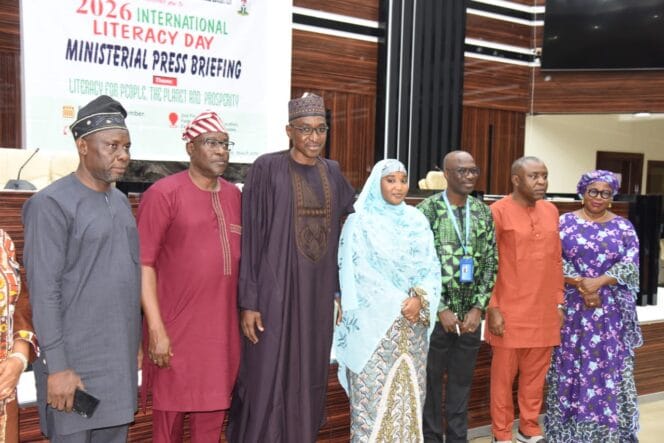
The Minister of State for Education, Prof. Suwaiba Said Ahmad, made this known on Friday in Abuja during a ministerial briefing to mark the 2026 International Literacy Day. The theme for this year is “Literacy for People, the Planet and Prosperity.”
Ahmad said the updated approach views literacy as more than just reading and writing. She described it as the bedrock for human dignity, economic involvement, digital access, vocational growth and sustainable development.
A key highlight of the renewed effort, she said, is the reinstatement of NMEC’s institutional and academic independence. This, she noted, will allow the commission to plan better, coordinate mass literacy programmes and improve accountability in the delivery of adult and non-formal education.
According to her, the government is also putting money into adult education infrastructure. This includes upgrading facilities at the National Centre for Adult Education in Kano, building infrastructure in other parts of the country, and plans to establish a permanent head office for NMEC.
The Minister added that community learning centres are being set up nationwide to bring education closer to people shut out of the formal school system, especially in rural and underserved areas.
She explained that NMEC staff will work as teachers and facilitators at these centres, offering flexible learning options for young people and adults who could not complete or access formal schooling.
“The centres will create flexible and easy pathways for youths and adults who missed out on formal education,” Ahmad said.
However, the renewed push comes with a major data challenge. The newly appointed Executive Secretary of NMEC, Prof. Dahiru Muhammad Shuni, said the commission currently lacks current national data on literacy levels in Nigeria, with the last available figures from 2010.
Shuni described the gap as unacceptable and said efforts are ongoing to get up-to-date and reliable data on how many Nigerians are affected by illiteracy.
He said having current data will help the commission and partners better grasp the size of the problem and design solutions that fit present realities.
Ahmad also stressed that government cannot solve the literacy problem alone. She called for stronger collaboration with state and local governments, development partners, CSOs, traditional and religious leaders, the private sector, community heads and the media.
She said the Federal Government is determined to ensure rural areas are not left behind as technology, digital learning and artificial intelligence become more central to education.
“We are making sure teachers in both rural and urban areas are not disadvantaged because of where they are located,” she said.
The Minister further urged the new NMEC leadership to be more proactive and inclusive, and to work across sectors so literacy programmes reach the people who need them most.
Speaking on Nigeria’s progress toward Sustainable Development Goal 4, which aims for inclusive and quality education, Ahmad said the country is making notable gains. She noted that SDG 4 goes beyond adult literacy to cover education at all levels.
Also speaking, Mr. Oladeji Adeyemi, Head of Education at the UNESCO Abuja Office, said global literacy has improved a lot in the last decade. Over 88 per cent of the world’s population can now read and write, up from about 65 per cent previously.
Adeyemi, however, noted that millions of people still face illiteracy. He pointed to UNESCO-supported projects in Kano State as an example of how literacy programmes can go beyond reading, writing and arithmetic to include health, wellbeing and family-life education.
As Nigeria marks the 2026 International Literacy Day, the Federal Government said its new strategy will focus on bringing learning opportunities to the doorsteps of underserved citizens and turning literacy into a route to dignity, skills, economic opportunity and shared prosperity.