BY Achilleus-Chud Uchegbu
Minister of Works, Mr David Nweze Umahi, may just be coming to terms with the reality that in Nigeria, political power does not collapse in a single dramatic moment. It always comes as a process of seemingly inconsequential events. Political power in this environment erodes through small, visible signals that insiders read long before the public comes to terms with the reality. Those small and inconsequential events are signals that the carpet is about to be pulled off. Insiders know how it works out. Outsiders don’t.
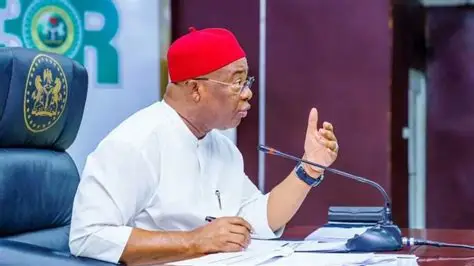
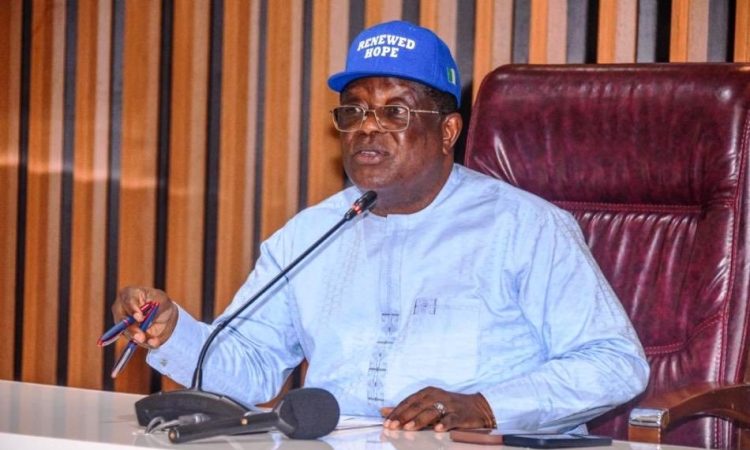
For those who understand how the game is played, the interruption of his speech at the Kaduna All Progressives Congress (APC) campaign flag-off, and the embarrassing retrieval of the microphone from his hands, is one of those signals. Those who play in a political league where deference to party elders and senior officials is prized, few things could be more telling than a senior minister, one who purports to hold the key to the party leader’s heart, being cut off in front of his own party’s crowd. Irrespective of whatever the immediate cause was, the humiliating scene suggests that the people closest to Umahi have stopped treating him as an untouchable. That should give him heartaches and get him closer to stronger blood pressure pills than any opposition attack or disparagement from his kin in the southeast before whom he had presented himself as the lion of the region. Lions do not cringe before rabbits. But in Kaduna, the ‘lion of the southeast’ tucked his tail between his legs and walked down the podium. He was treated to a fest he did not anticipate.
The most telling issue in the episode was the setting where someone chose to give him the treat. Campaign flag-offs are carefully stage-managed events. Speaking order, time allocation, and who holds the microphone are decided in advance by party organisers, state chapters, and the people with the most to lose from a stumble. This means that when a sitting federal minister, a supposedly powerful one at that, is interrupted and the microphone is taken from him, it is not just a random lapse of protocol but a choreographed stage play. Someone decided that Umahi’s rendezvous was over. Taking away the microphone from him in the manner that they did was obviously a decision made by people, or someone who understands that a politician’s authority at the podium reflects the authority he commands behind the scenes. Therefore, when a minister who still holds political capital within his party is embarrassed in public, it suggests that the minister’s allies no longer feel obligated to protect him. Ordinarily, no minister, no matter how lowly ranked, will be subjected to such a humiliation on a day the party flagged off its presidential campaign.
Dishing out that treatment to Umahi could also reflect a broader pattern of how Umahi has been received within the party. Umahi has been a figure of considerable ambition, moving between parties and building a reputation as a forceful, outspoken operator. He aspired to the presidency in the 2023 election and has also said he is best suited to contest the presidency whenever the pendulum swings eastwards. This makes him a man of immeasurable ambition. His ambition is not misplaced. However, as a serving minister, he has a strong personality. In politics, strong personalities attract loyalty when they deliver to general expectations. They, however, attract resentment when they appear to be serving their own advancement. In consistently voicing his ambition, Umahi failed to realise that politicians who are seen as more interested in their next position than in the work in front of them tend to accumulate rivals quietly. When such rivals sense weakness, they move in and decimate. On this ground, the humiliation in Kaduna looks less like a spontaneous outburst than the visible end of a long period of tolerance. Those who have their eyes on the presidency after Bola Tinubu may not want such an ambitiously disruptive character pulling strings around them.
Besides, Umahi has been chattier than he has worked. As the Minister of Works, Nigeria’s road network, which is among the most consequential public assets in the country, are within his supervisory powers. Roads determine how farmers get produce to market, how manufacturers move goods, how citizens reach hospitals and schools, and how much time and money the economy loses every day in traffic and on broken surfaces. A Minister of Works in Nigeria is often judged by a simple question: are the roads being built, maintained, and repaired? All Ministers of Works since 1999 -Anthony Anenih, Adeseye Ogunlewe, Obafemi Anibaba, Cornelius Adebayo, Hassan Muhammed Lawal, Mohammed Daggash, Mike Onolememen, Babatunde Fashola- have faced this critical question. Measured against that question, Umahi’s record invites serious scrutiny. He has been far more prolific in announcements, inspection tours, deadlines, and public assurances than in visible completed work that ordinary citizens can drive on. As a “Professor of Practice”, Umahi knows that commissioning ceremonies and ambitious timelines are easy to produce, but sustained, quality road maintenance is harder, slower, and less camera-friendly. Fortunately, that is precisely the kind of work that defines a minister’s success.
Critics argue that his pattern of talk outpaces his delivery. They could be right. Umahi understands that in Nigeria, strong public statements generate headlines and political credit, while the unglamorous work of contract supervision, funding follow-through, and maintenance schedules goes largely unseen until a road collapses or a bridge becomes impassable. Often, by the time the public finally notices the gap, the minister has already moved on to pontificating about the next project. But a ministry built on announcements rather than results eventually runs out of credibility, and that was exactly what he achieved when he announced the stoppage and diversion of the Lagos-Calabar Coastal Road. So, it is not impossible that the Kaduna show was a way to remind Umahi that he had talked the Tinubu and APC government into public ridicule and needed to talk no more.
Meanwhile, there is a practical lesson in how the microphone was taken from him. In politics, the people who matter most are rarely the opposition. They are the colleagues who decide who gets the platform, who gets the nomination, and who gets the next appointment. When those colleagues begin to signal impatience publicly, it usually means private conversations have already concluded that the minister is of no additional value. This interpretation of the incident in Kaduna suggests that Umahi now faces the difficult task of rebuilding goodwill with party structures, and he cannot do that through rhetoric alone. Politicians who recover from moments like this typically do so by demonstrating tangible results that their colleagues can point to and defend. For now, even his colleagues from the southeast region, especially those who ply the Enugu-Abakaliki expressway, cannot defend his record.
For the Nigerian public, the lesson is equally clear. Citizens should judge officials by what they have actually built and maintained, not by how often they appear at podiums. A minister’s speeches are cheap. Roads that carry traffic safely for years are not. The Kaduna embarrassment offers a useful moment to ask whether the Ministry of Works has been delivering at a scale that responds to the Renewed Hope Agenda of President Bola Tinubu. Are road users in Nigeria feeling the positive impact of Tinubu’s government on the federal highways? In a few more days, the annual Christmas holiday exodus from the north and Lagos will commence. Will the travellers have reason to trust Tinubu for another term or adjudge the minister responsible as more interested in headlines than results?
If Umahi wishes to change the trajectory the Kaduna humiliation points toward, he must shift from speaking about roads to proving them. He should publish verifiable project timelines, make contract progress transparent, and let completed and maintained roads speak louder than his podium presence. Otherwise, the microphone taken in Kaduna may prove to be only the first of many moments in which the people around him will have to decide that he has talked enough.