Charity Simon
The Minister of State for Education, Prof. Suwaiba Ahmad, has said teachers must be digitally skilled to adequately prepare students for today’s technology-driven world.
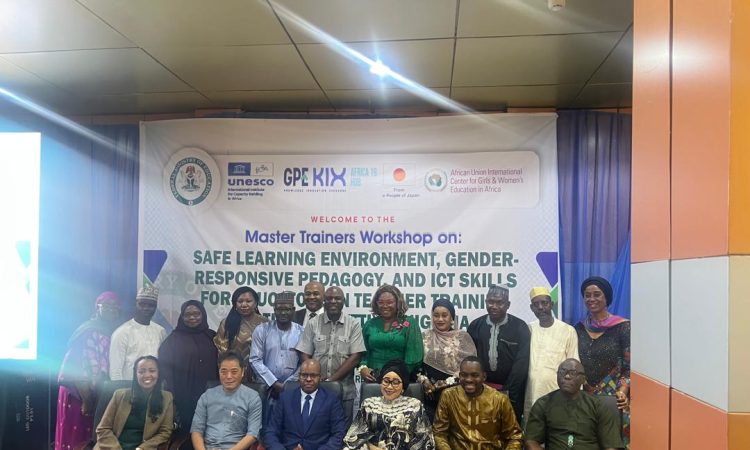
Ahmad made the call on Monday at the National Trainers’ Workshop on Safe Learning Environment, Gender-Responsive Technology and ICT Skills for Educators in Teacher Training Institutions in Nigeria, held at Newton Park Hotel and Resort, Abuja.
According to her, digital competence has become a necessity for teachers, not a choice.
“A teacher has to be digitally sound and enabled to be able to impact adequate knowledge to students in a digital era,” she said, urging educators to embrace technology as a critical tool for effective teaching and learning.
The workshop, organised with support from UNESCO and the Government of Japan, brought together 45 master trainers from 15 Colleges of Education across the country to build their capacity in safe learning environments, gender-responsive pedagogy, digital teaching and prevention of school-related gender-based violence.
Ahmad said the training is in line with the Federal Government’s Education Sector Renewal Initiative, which prioritises expanding access to education, improving teaching quality, promoting school safety and integrating technology into learning.
She also highlighted the implementation of the National Policy on Anti-Bullying in Nigerian Schools, stressing that the success of the policy rests on teachers’ ability to detect bullying, support victims and respond appropriately.
The Minister noted that millions of Nigerian children are still left behind despite being in school, citing UNICEF’s 2024 report that 74 per cent of children aged 7 to 14 lack basic reading and mathematics skills.
She explained that every child deserves not just access to school but a safe, inclusive and supportive learning environment where they can thrive.
According to her, the workshop will equip the 45 master trainers with advanced knowledge, which they will cascade to about 500 teacher educators, significantly multiplying the impact of the programme nationwide.
Ahmad commended the Government of Japan, UNESCO, the UNESCO Abuja Office, the African Union International Centre for the Education of Girls and Women in Africa, AU/CIEFFA, the Nigerian National Commission for UNESCO, NATCOM-UNESCO, and participating colleges of education for supporting the initiative.
She described the digital equipment donated to the colleges as a practical investment in the future of teacher education, urging participants to fully utilise projectors, smart boards, tablets and other ICT tools during and after the training.
The Minister encouraged teacher educators to demonstrate practical classroom applications of technology, including developing inclusive lesson plans, adapting digital learning materials and effectively using ICT tools even in low-connectivity areas.
She further urged the master trainers to return to their institutions and institutionalise the knowledge gained, rather than treating it as a one-off workshop.
Prof. Ahmad concluded by calling on educators to create classrooms where every child feels safe, valued and heard, noting that well-trained teachers can determine whether a child stays engaged in school or quietly falls behind.