Charity Simon
The Minister of Education, Dr. Maruf Tunji Alausa, has said that President Bola Ahmed Tinubu has delivered on nearly all the pledges he made during the 2023 election campaign, stressing that Nigerians are now seeing real and measurable progress under the current government.
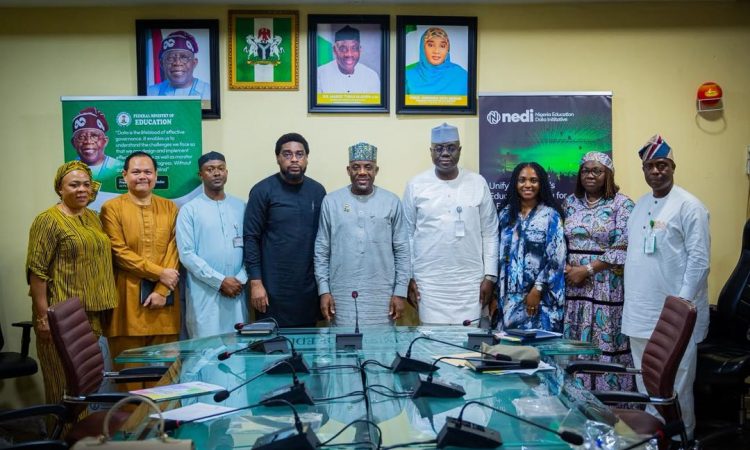
Alausa spoke in Abuja at the weekend while receiving the 2025 Nigeria 2050: Child Foresight Analysis for Futures Literacy and Intergenerational Equity.
The report is a key project of the Anticipatory Governance and Foresight Capacity Programme in the Office of the Vice President, delivered with technical backing from UNICEF.
The delegation that presented the report was led by the Programme’s Director-General, Chris Ngwodo, alongside Mohammed Ahmed, the Special Assistant on Special Duties to the Vice President.
According to Alausa, the report’s insights are critical because Nigeria has a very young population. He noted that about 70% of the country’s estimated 220 million people are under 30 years old.
He said this age structure is both a huge opportunity and a pressing duty for government to ensure young people get quality education, job-relevant skills, and real chances to thrive.
The Minister argued that the Tinubu administration’s impact is no longer just talk, but is visible in policies and results across different sectors, especially in education.
“I can state this confidently because we now have a President who is steering the country from the front, with strong integrity, dedication, love for the country and a firm resolve to transform Nigeria,” he said.
He added: “This is not mere talk. We are witnessing concrete benefits and real transformation across the country.”
Alausa said Nigeria has moved past the period of uncertainty in national development and is now focused on building on achievements while closing existing gaps.
“The country is no longer at a crossroads. We still have a lot of ground to cover,” he stated.
He identified education as a central pillar of the government’s reform plans, noting that the Federal Ministry of Education has received strong backing to drive initiatives under the Renewed Hope Agenda.
The Minister said education is key to the administration’s goal of building a $1 trillion economy.
He explained that the Nigerian Education Sector Renewal Initiative (NESRI) is leading reforms across the system, with focus on Technical and Vocational Education and Training (TVET), STEM, teacher quality, quality assurance, reducing out-of-school children, and improving education data and digital systems.
He noted that the renewed emphasis on TVET is changing how Nigerians view technical education. It is also opening new routes for youth to gain practical skills, start businesses, get jobs, and advance to higher education.
“Skills are what matter now and in the future,” he said, adding that Nigeria can no longer run an education system that does not prepare young people for today’s economy.
Alausa also tied investments in medical education and professional training to efforts to tackle skill gaps that fuel migration, commonly called “Japa.”
He said that despite having many young people eager to train, Nigeria has continued to face shortages of nurses and other health workers.
In response, the government has expanded access to nursing schools and increased training capacity in teaching hospitals, federal medical centres, and specialist hospitals, he said.
The goal, according to him, is to give more Nigerians quality professional training locally while building a workforce that can compete globally.
The Minister also spoke on the government’s growing use of data for education planning, especially in estimating the number of out-of-school children.
He questioned the widely quoted figures of 15 million to 17 million, saying they were often used without proper household-level verification.
Preliminary findings from state household surveys, he said, suggest the numbers may have been greatly overestimated.
Citing Kaduna State, Alausa said a survey that covered over 90% of households put the number of out-of-school children at under 190,000, compared to a previous estimate of about 585,000. Another earlier projection of 1.2 million also dropped to below 100,000 after the survey.
Jigawa State, he added, also saw big differences between old estimates and new household data.
He stressed that accurate data will help government pinpoint where children are out of school, understand why, target solutions better, and track if children who re-enrol stay in school.
“Even if the numbers drop sharply, one child out of school is still too many,” he said.
Alausa disclosed that over one million children have been moved from the streets into classrooms nationwide in the last two and a half years. In Jigawa alone, more than 180,000 children were enrolled in the past two years.
The next task, he said, is to keep them in school and stop new dropouts.
He said the government is leveraging digital education data for this, citing progress in the 2026 Annual School Census through the digitised Nigerian Education Management Information System (NEMIS).
So far, over 56% of public schools and 41% of private schools have uploaded their 2026 census data to the platform.
“Without data, you are operating in the dark. Data tells you everything,” Alausa said.
He added that the information will help the ministry identify gaps in access, track enrolment, plan infrastructure, and evaluate the impact of education programs.
The Minister also said a nationwide assessment has been carried out to establish a baseline for literacy, numeracy, and cognitive skills at primary, junior secondary, and senior secondary levels.
The exercise, he said, will give a clearer picture of learning outcomes and help government measure how effective interventions are over time.
Alausa linked the ongoing reforms and data work to the Child Foresight Analysis, saying the future of Nigerian children cannot depend on projections alone.
He said the foresight project will help bring long-term planning, systems thinking, adaptive innovation, and youth involvement into national policy, while safeguarding the interests of future generations.
He commended the Office of the Vice President, the Office for Strategic Preparedness and Resilience (OSPRE), and UNICEF for supporting the initiative.
He described the Child Foresight Analysis as a vital tool for shifting Nigeria from reactive governance to proactive, forward-looking action.
The Minister said his ministry will align the report’s findings with NESRI, especially on future literacy, long-term education planning, skills, data systems, and fairness across generations.
He urged stakeholders to move beyond theory and connect their work to reforms already happening in education and other sectors.
Ultimately, he said, progress will be judged by whether Nigerian children and youth get better education, gain relevant skills, access opportunities, and contribute meaningfully to nation building.
“Nigeria has changed, and the change is here to stay,” the Minister concluded.